North Carolina.
part 1, page 1
The Good Book tells us that the Lord planted a garden eastward in Eden. This beautiful garden was called Paradise. In it he placed man, formed in His own image, the possessor of life and happiness. He was tempted and fell, and his estate forfeited: and, with a curse upon his head, he was driven from lovely Eden. Westward his face was set; westward his children were still driven, leaving their parental estate behind. Westward, still westward, they continued to go; and although they were leaving their ancestral abode still farther in the rear, they were all the time coming nearer to the condition which man first enjoyed in Paradise. Finally reaching the shores of the great Atlantic or Western Ocean, with the spirit of Cain still pressing or scourging them, they took ships; and with their covenant and its promise bade adieu to the east-
part 1, page 2
ern lands, steering westward with nothing but black waters before them. They found a land, - a goodly land, - a new world of primeval forests; and then their hopes grew brighter and their hearts stronger, while their minds expanded with new ideas and happier fancies of Paradise regained. We need not tell the reader the second "El Dorado" was North Carolina.
Had the computation of time in 1584 been as it is now, it would have been a singular coincidence that the first English colonists to America should have landed on the coast of North Carolina on the anniversary of the day since rendered so memorable by more than one event in our history as an American nation. Our historians truthfully relate that the portion of the United States, first called Florida, then Virginia, then Carolina, and finally North Carolina, may indisputably, and justly, claim the honor of having received the first English colony that was planted in the Western Hemisphere. The story of its trials, disasters and final failure, carries us back to a memorable period in Old England’s history. It is needless to remark that the story of the early settlement derives additional interest from its association with the life of one of the most remarkable men, in an age when remarkable men were by no means uncommon. The reign of Queen Elizabeth and Sir Walter Raleigh present to the historian of North Carolina the first actors in the early scene of which that State has been the theatre. History informs us that, at that time, over three hundred years ago, England was ruled by good Queen Elizabeth, who reigned many years and so wisely that England became, every year, more prosperous and more powerful. Her ships whitened every sea and her brave sailors and soldiers were sent around the world, and were only too glad to discover and claim new kingdoms for their fair queen.
Seconded by this good queen, Sir Walter Raleigh, as we have already hinted, sent out two vessels under the command of Philip Armidas and Arthur Barlow. These brave captains, on the 27th of April, 1584, sailed in search of new discovered land. Pursuing a southwesterly route, they touched at the Canary Islands on their passage; and sailing thence northward they soon got sounding in a region where the air of the early summer was laden with the aroma of flowers and fragrant shrubs. These balmy breezes came from the shores of "North Carolina;" and after ranging the coast for one hundred and twenty miles, the adventures entered, on the 4th of July, 1584, the first haven which offered, devoutly returned thanks to Almighty God; and, in the name of the queen of England, took formal possession of the country.
The scene of this interesting ceremony was an island called Wokoken; and the event happened in early summer, when that Eastern region appeared in its richest glory. The imaginations of the adventures were filled with pleasing images and glowing fancies. The blue heavens were not obscured by a cloud and on the tranquil bosom of the water gleamed innumerable islands. The air was redolent with the perfume of many tinted flowers and vocal with songs of birds; and among the giant trees, draped with hoary moss and festooned with luxuriant vines, were bowers and cool arbors where nature and her children reposed in dreamy tranquility. An air of romance seemed to pervade the region; and the native inhabitants, artless, gentle and generous, awakened images of a golden age and Arcadian pleasures. The story of this settlement, beautiful as it is, is too long to be continued here. The reader must be informed that the soil of North
part 1, page 3
Carolina is forever sacred from several important facts. The first English man and the first English woman pressed with their feet this soil. Here was born the first English child, and named in honor of her maiden queen, "Virginia Dare." This was the name given at the first baptism of an English child. Here, too, on the Island of Roanoke, was the first Indian baptised, and here was the first title of nobility conferred on this same Indian, who, under the same direction of Raleigh, was invested with the rank of a federal Baron, as the "Lord of Roanoke." "This," says Bancroft, "was the first peerage erected by the English in America, remaining a solitary dignitary till Locke and Shaftsbury suggested the establishment of a palatine in Carolina, and Mantero shared his honors with the admired philosopher of his age." In a letter, bearing date of September 3rd, 1585, New Fort, in Virginia (as Carolina was then called) and written by Gov. Ralph Lane, we have his impressions of North Carolina. This Ralph, in 1585, seems to have been as thoroughly enchanted as, later on, we shall see Mr. Juilan Ralph was, in 1895, only three hundred and ten years, with this self-same North Carolina and without the aid of the hand-book, issued under the auspices of the North State Columbian Exposition, he thus expressed himself: "It is the grandest soil under cope of heaven, the most pleasing territory in the world. The continent is of huge and unknown greatness and very well peopled and towned, though savagely; the climate is so wholesome that of one hundred and ten souls we have had no one sick during the three months since we touched land. If Virginia had but houses and cattle and was peopled with English no realm in christendom were comparable to it. For this we already find that in what commodities soever, Spain, France, Italy or East parts, do yield to us in vines of all sorts, in oil, in flax, in raisins, pitch, frankincense currants, sugars and such like, these do abound, with the growth of them all. And sundry other rich commodities that no parts of the world, be they East or West Indies, have; here we have great abundance of. The people are naturally more courteous, and very desirous to have coarse cloth rather than silk. Thus, My Dear Sirs, I have joined you both in one letter of remembrance and most heartily I commend you to the protection of Almighty God.
"Your most assured friend,
Ralph Lane".
The historian Foote informs us "that North Carolina, in the days of colonial dependence, was the refuge of the poor and the oppressed. In her borders the emigrant, fugitive and exile found a home. Whatever may have been the cause of leaving the land of their nativity, political servitude, tyranny over conscience, or poverty of means, with the hope of bettering their condition, the descendents of these enterprising, suffering, afflicted, yet prospered people, have cause to bless the kind Providence that led their fathers, in their wandering, to such a place of rest." Her sandy plains and threatening breakers, jutting out into the ocean, met the voyagers sent out by Sir Walter Raleigh, in 1584, and the island of Wokoken afforded the landing place, "as some delicate garden abounding with all kinds of odoriferous flowers," and witnessed the ceremonial of taking possession of the country for the Queen of England, who soon gave it the name of Virginia. The Island of Roanoke, between Pamlico and Albemarle Sounds, in the
part 2, page 7
domains of Granganimeo, afforded the first colony of English a home so quiet and with a climate so mild, and with fruits so abundant that the tempest-tossed mariners extolled it in their letters to their countrymen as an earthly paradise. So, no doubt, it seemed to them the first summer of their residence in 1585; and notwithstanding the disastrous conclusion of that and succeeding colonies so the adjoining country has seemed, to many nations that have risen, flourished and passed away in the long succession of years since the wife of Granganimeo, in savage state, feasted the first adventurers. Her extended campaign, around the head streams of the numerous rivers that flow through her own borders and those of South Carolina, to the ocean, cherished into numbers and wealth, civil and religious independence, the emigrants from a rougher climate and more unfriendly soil of the north of Ireland and the highlands of Scotland. The quiet of the vast solitude of North Carolina lured these hard working men, who, in their poverty and trans-Atlantic subjection, cherished the principles of religion, wealth and independence, to seek in them the abode of domestic blessedness and the repose of liberty. Far from the ocean, in a province without seaports and unfrequented by wealthy emigrants, the clustered settlements had space and time to follow out their principles of religion, morality and politics to their legitimate ends; and the first declaration of entire independence of the British crown was heard in the province that afforded a resting-place to the first colony.
Carolina was settled by emigrants from different parts of the kingdom of Great Britain and her American provinces, in such numbers and in such remote situations, that it is easy to follow the line of their descendants and trace out the workings of their principles and habits upon themselves, the commonwealth and the country at large. Every state of society owes much of its character for excellence or demerit to the preceding generation: the present is a reflected image of the past; and men must search among their ancestors for the principles and causes and springs of action and mouldering influences that have made society and themselves what they are. The present generation of Carolinians look back to these men that drove the wild beasts from the forests and displaced the savages, as the fathers of a republic, more blessed than the most favored progenitor boasting of antiquity or nobility; and may well ask - What principles of religion and morals; what habits made us what we are? In answer to these questions there is no good civil history of the state; and with the honorable exception of the life of Caldwell, by Caruthers, there is no church history; and the traditions that reached back to the settlement of the country, are, for the most part, passing away, or becoming dimmed by the horizon of uncertainty. The prospect, then, is that the coming generation will be ignorant of their ancestors and their deeds, and like the Greeks and Romans, be compelled to go back to a fabulous antiquity to search in dreams and conjectures for the first link in a chain of causes, the progression of which is full of blessedness. It may be well for some people that the mist of antiquity hides in uncertainty the lowness of their origin; and such aspersion has sometimes been cast on Carolina. But if any people may glory in their forefathers, the Carolinians, or at least part of them, may glory in theirs and cherish their principles with the firm confidence that they will make their descendants better and that the progress of excellence shall never end. No human mind
part 3, page 7
can tell with certainty, or even conjecture plausibly, where the principles of the men, that did so much for their posterity, will lead; though they may be certain that the pathway will be resplendent and the goal glorious.
The history of principles is the history of states; and the youth of Carolina might study both on one interesting page, were there a fair record of past events presented for their perusal. They might learn of their own state something better than the histories of Greece and Rome, or than the Assyrian, the Babylonian , or all the Eastern and Western empires of the world, have ever taught. They would find examples worthy of all praise, and actions deserving a generous emulation. They would be impressed more deeply with the conviction that the people and actions worthy of such examples must be the citizens and the acts of the happiest nation on earth.
North Carolina was settled by the freest of the free; by men to whom the restraints of other colonies were too severe. This is the statement of Bancroft. The same historian tells us "if any one doubts man’s capacity for self government, let him study the history of North Carolina."
A fondness for political as well as religious freedom, was a characteristic of those first recognized as settlers in North Carolina; and as early as 1678 there was another deliberate uprising of the people and a complete revolution. A governor was deposed and another elected in his place; and a manifesto was published, or drawn and signed, breathing the same bold spirit and uttering doctrines and sentiments much like those which, a century later, pervaded the thirteen colonies of British America. Bancroft describes them exactly when he says, "Its inhabitants were restless and turbulent in their imperfect submission to a government imposed on them from abroad; the administration of the colony was firm, humane and tranquil when left to take care of themselves. Any government but one of their own institution was oppressive." The manifesto issued in 1678 was the first paper issued on the American continent claiming and assuming independence with the right of self government, showing that "coming events cast long shadows before them."
The people were of various nationalities; but as they all had fled from persecution they easily became homogenous, and are so today. They were French, English, German, Swiss, Highland Scotch, Scotch-Irish, Quakers and Moravians. Under their thrifty culture the wilderness soon blossomed. The heads of clans and chiefs of distinction brought many a name famed in Scottish song and story to the Cape Fear country; and the beautiful and famous heroine, "Flora McDonald," spent a portion of her life on the banks of Cross Creek, in the beautiful town of Fayetteville, North Carolina. The names of our citizens indicate today these various settlements and nationalities as clearly as one hundred and fifty years ago. Under the administration of the royal Governor Johnson, large accessions from various sources were made to North Carolina’s population. He was a firm friend to the royal government, but from long residence he understood our people, liberalized his views and conciliated the different classes. He governed peacefully twenty years. Governor Dobbs, an Irishman, who succeeded him, failed to
part 4, page 7
profit by the Scotchman’s example, and soon the foundations of the law became loosened and a universal discontent prevailed among the people and colored all the proceedings of her legislation. Under these circumstances the muse of history informs that it was thought proper to let Governor Dobbs retire "for the benefit of his health;" and William Tryon was sent to take his place.
Every school child in America is familiar with the story of the Boston Tea Party, where some of the citizens of Boston, disguised as Indians, tossed the tea from the British ship into the Boston Harbor. The name of Tyron, who was more famous, perhaps, than all the other royal governors recalls the story of the Diligence, which contained the stamped paper and which arrived in the Cape Fear and anchored before the town of Brunswick. Tyron issued a proclamation announcing the persons authorized as distributors of stamps and called on the people to make application for the same. Our North Carolina Stamp Party, undisguised as Indians, appeared armed as militiamen, under Ashe and Waddell, and informed the commander of the vessel that the landing of the stamps would be resisted. The officer promised to remain quiet; the militiamen returned to Wilimington in triumph. The citizens joined in the procession and that night the town was illuminated. The next day, Houston, the stamp-master, was taken from the governor’s mansion and in the market place, in the presence of a large multitude, took a solemn oath never to perform the duties of his office.
Truth is the daughter of time, though it may linger for centuries in the womb of its parent. This stirring incident has been overlooked, and to future historians of the struggle for human freedom, we commend it as " a gem of purest ray serene," yet by no means the brightest in the diadem of Carolina.
On the repeal of the Stamp Act, the assembly of North Carolina, eighty in number, unanimously thanked the governor and also unanimously resolved: "First, that the right of imposing taxes had ever been vested in the assembly. Second, that they claim the undoubted right to petition. Third, that trials of treason must take place here in North Carolina." The governor dismissed or dissolved this body, declaring that these resolutions sapped the very foundation of confidence and gratitude. The people of North Carolina were cheated and imposed upon by officers of every grade; and the truth of history will yet dispel the charges of riot and licentiousness made by Williamson, her historian, on the masses of the province. The grossest injustice has been done this state; and until recently some of the most illustrious incidents in her career have been made to appear as dark and damning blots on the escutcheon of her fame. The writer needs only to cite the war of the Regulators, culminating in the battle of Alamance. Here the spirit of liberty made its first essay on American soil, spilt the first blood, displayed the banner of the Sons of Liberty and unsheathed Liberty’s sword. Thereupon it gathered strength in every field, its immortal energies expanding with time and trials, finally drove British oppression from America and brought the whole continent "to a just regulation." "And if the Phaeton and horses of fire had been destined for the translation" of the martyrs who fell at Alamance, history will yet write that they "could scarcely have departed in a brighter blaze of
part 4, page 8
glory." This celebrated battle was fought on the banks of Almanace Creek, in North Carolina, May 16, 1770. The battle of Lexington, Concord and Bunker Hill were but the natural sequences to the spirit which pervaded the Carolinians at the battle of Alamance.
- No stately column marks the hallowed place,
- Where silent sleeps, unurned, their sacred dust,
- The first free martyrs of a glorious race,
- Their fame and perfect wealth, a nation’s trust.
- No stern ambition waved them to the dead,-
- In freedom’s cause they nobly dared to die;
- The first to conquer or the first to bleed,
- God and their country’s right, their battle-cry.
- Immortal youth shall crown their deathless fame,
- And as their country’s glories still advance,
- Shall brighter blaze o’er all the earth’s fair name,
- Thou first-fought field of freedom - "Alamance!"
Tyron soon left the state and was succeeded by Martin, who certainly reaped the whirlwind where his predecessor had sown the wind. He was driven from the state by the patriots in the East, while in the West the Scotch-Irish were as thoroughly patriotic, as the following pages, from our best and only truthful historian of that era, will clearly prove. He is a foreigner, like Ralph Lane and Julian Ralph. "Let another praise thee, and not thine own mouth," is the advice of Solomon. Hear what Francois Martin, the historian, says happened in Charlotte, North Carolina, May 19th, and 20th, 1775, a proud and natural sequence to the battle of Alamance. In order that the reader may fully appreciate the character of the meeting, we insert a part of Chapter XI of Martin’s History of North Carolina. It runs as follows:
"In the months of March and April, 1775, the leading men of the county of Mecklenburg held meetings to ascertain the sense of the people, and to confirm them in their opposition to the claims of parliament to impose taxes and regulate the internal policy of the colonies. At one of the meetings, when it was ascertained that the people were prepared to meet their wishes, it was agreed that Thomas Polk, then colonel commandant of the county, should issue an order, directed to each captain of militia, requesting him to call a company meeting to elect two delegates from his company, to meet in general committee at Charlotte on the 19th day of May; giving to the delegates ample power to adopt such measures as to them should seem best calculated to promote the common cause of defending the rights of the colony and aiding their brethren in Massachusetts. Colonel Polk issued the order, and the delegates were elected. They met in Charlotte at the appointed time. The forms of their proceedings and the measures to be proposed had been previously agreed upon by the men at whose instance the committee was assembled. The Rev. Hezekiah J. Balch, Dr. Ephraim Brevard and William Kennon, Esq., an attorney-at-law, addressed the committee and descanted on the causes which had led to the existing contest with the mother country; and the consequences which were to be apprehended, unless the people should make a firm and energetic resistance to the right which parliament asserted, of taxing the colonies and regulating their internal policy.
part 5, page 7
On the day on which the committee met, the first intelligence of the action at Lexington, in Massachusetts, on the 19th of April, was received in Charlotte. This intelligence produced the most decisive effect. A large concourse of people had assembled to witness the proceedings of the committee. The speakers addressed their discourses as well to them as to the committee; and those who were not convinced by their reasoning were influenced by their feelings, and all cried out: ‘Let us be independent! Let us declare our independence and defend it with our lives and fortunes!’ A committee was appointed to draw up resolutions, which it was intended should be submitted to the general committee. Dr. Ephraim Brevard had drawn up the resolutions some time before, and now reported them, with amendments, as follows:
"Resolved, that whoever directly or indirectly abets, or in any way, form or manner, countenances the invasion of our rights as attempted by the parliament of Great Britain, is an enemy to this country, to America, and to the rights of man.
" ‘Resolved, that we, the citizens of Mecklenburg county, do hereby dissolve the political bonds that have connected us with the mother country, and absolve ourselves from all allegiances to the British crown, abjuring all political connection with a nation that has wantonly trampled on our rights and liberties, an inhumanly shed the blood of American citizens at Lexington.
" ‘Resolved that we do hereby declare ourselves a free and independent people; that we are, and of a right ought to be, a sovereign and self governing people, under the power of God and the general congress; to the maintenance of which independence we solemnly pledge to each other our mutual co-operation, our lives, our fortunes and our most sacred honor.
"Resolved, that we do hereby ordain and adopt rules of conduct all and each of the former laws; and the Crown of Great Britain cannot be considered hereafter as holding and rights, privileges or immunities amongst us.
" ‘ Resolved, That all officers, both civil and military, in this country, be entitled to exercise the same power authorities as heretofore; that every member of this delegation shall henceforth be a civil officer and exercise the power of a justice of the peace, issue process, hear and determine controversies according to law, preserve peace, union and harmony in the country until a more general and better organized system of government be established.
" ‘ Resolved, That a copy of these resolutions be transmitted by express to the president of the Continental Congress assembled in Philadelphia, to be laid before that body.’
"These resolutions were unanimously adopted and subscribed by the delegates. James Jack, then of Charlotte, but now residing in the state of Georgia, was engaged to be the bearer of the resolutions to the president of Congress, and was directed to deliver copies of them to the delegates in Congress from North Carolina. The president returned a polite answer to the address which accompanied the resolutions, in which he highly approved of the measures adopted by the delegates of Mecklenburg, but deemed the subject of the resolutions premature to be laid before Congress. Messrs. Caswell, Hooper and Hewes forwarded a joint letter, in which they complimented the people of Mecklenburg for their zeal in the common cause, and recommended to them the strict observance of good order; that the time would come when the whole continent would follow their example.
"On the day that the resolutions were adopted by the delegates in Charlotte, they were read aloud to the people who had assembled in the town; and proclaimed amidst the shouts and huzzas, as expressing the feeling and determination of all present. When Captain Jack reached Salisbury, on his way to Philadelphia, the general court was sitting; and Mr. Kennon, an attorney at law, who had assisted in the proceedings of the delegates at Charlotte, was then at Salisbury. At the request of the judges, Mr. Kennon read the resolutions aloud in open court to a large concourse of people. They were listened to with attention and approved of by all present. The delegates at Charlotte being empowered to adopt such measures as would in their opinion best promote the common cause, established a variety of regulations for managing the concerns of the county. Courts of justice were held under the direction of the delegates. For some months these were held at Charlotte; but for the convenience of the people (for at that time Cabarrus formed a part of Mecklenburg) two other places were selected, and the courts were held at each in rotation. The delegates appointed a committee of their body who were called ‘a Committee of Safety;’ and they were empowered to examine all persons brought before them. Those who manifested penitence for their Toryism, and took an oath to support the cause of liberty and the country, were discharged. Others were sent under guard into South Carolina for safe keeping. The meeting of the delegates at Charlotte, and the proceedings which grew out of that meeting, produced the zeal and unanimity for which the people of Mecklenburg were distinguished during the whole of the revolutionary war. They became united as a band of brothers whose confidence in each other and in the cause which they had sworn to support was never shaken in the worst of times. In the Colonial Records, Vol. X., we find the proclamation of Governor Martin, issued August 8th, 1775. It is inserted here as contemporaneous history, and in the record of so important an event as that above is the best evidence of its truth. Here is the extract: ‘And whereas I have also seen a most infamous publication in the Cape Fear Mercury purporting to be the resolves of a set of people styling up a system of rule and regulation repugnant to the laws and subversive of his majesty’s Government.’"
In a state famous for gems of rare beauty and great value the Carolinian points with pardonable pride to the above well authenticated incident as the "Kohinoor" of all our historical jewels. In February of 1776 follows the great victory of Moore’s Creek, North Carolina, and shortly thereafter, in perfect unison with the above, we see that the provincial congress of North Carolina, at the summons of Samuel Johnson, assembled at Halifax on the 4th of April. This body was distinguished by the presence of those often alluded to in our histories as the leaders of the Whig party. The important question of independence was moved, discussed and unanimously approved by this congress, and this circumstance alone will perpetuate its fame. On Monday, the 8th of April, 1776, Cornelius Harnett, Governor Burke, Allen Jones, Thomas Jones, Governor Nash, Mr. Kinchin and Colonel Thomas Person were appointed a committee to take into consideration the usurpations and violences committed by the king and parliament of Britain; and on the succeeding 12th Mr. Harnett submitted the following report, which I am justified in pronouncing his own composition.
"REPORT ON THE SUBJECT ON INDEPENDENCE"
"It appears to your committee that, pursuant to the plan concerted by the British ministry for subjugating America, the King and parliament of Great Britain have usurped a power over the persons and properties of the people, unlimited and uncontrolled; and, disregarding their humble petitions for peace, liberty and safety, have made divers legislative acts pronouncing war, famine and every species of calamity against the continent in general. The British fleets and armies have been and still are daily employed in destroying the people and committing the most horrid devastations on the country. The governors in different colonies have declared protection to slaves who should imbue their hands in the blood of their masters. The ships belonging to America are declared prizes of war, and many of them have been violently seized and confiscated. In consequence of all which multitudes of the people have been destroyed, or from easy circumstances reduced to the most lamentable distress. And, whereas the moderation hitherto manifested by the United Colonies, and their sincere desire to be reconciled to the mother country on constitutional principles, have procured no mitigation of the aforesaid wrongs and usurpations, and no hopes remain of obtaining redress by those means alone which have been hitherto tried, your committee are of opinion that the house should enter into the following resolve, to wit:
"Resolved, That the delegates for this colony, in the Continental Congress, be empowered to concur with the delegates of the other colonies in declaring independence and forming alliances, reserving to this colony the sole and exclusive right of forming a constitution and laws for this colony and of appointing delegates from time to time under the direction of a general representation thereof, to meet the delegates of the other colonies for such purposes as shall hereafter be pointed out." (Journal of the Provincial Congress, pp.11 and 12).
These proceedings were on the 12th of April, and the resolution which was proposed was on that day unanimously adopted. It proceeded the recommendation of the Virginia Convention on the same subject by more than a month, and it is the first open and public declaration for independence by the proper authority of any one of the colonies on record. Is it anything wonderful, then, that Moncure D. Conway, with all the above light blazing in his face, I his life of Thomas Paine, should say: "In the matter of the evolution of independence, so far as resistance is concerned, the distribution of the honors has been rather literary than historical. In considering the beginnings of the Revolution our minds fly at once to the Tea Party in Boston Harbor, then to Lexington, where seven Massachusetts men fell dead, and seven years of war followed. But two years before the teas was thrown overboard, and four years before the Lexington massacre, North Carolina had encountered British troops, had left two hundred patriots fallen, and seen their leaders hanged for treason. Those earliest martyrs are almost forgotten, because, in the first place, North Carolina produced no historians, poets or magazines to rehearse their story from generation to generation. In the second place, the rebellion which Governor Tryon crushed at Alamance, though against the same oppression, occurred in 1771, before the colonies had made common cause." This same author says that the North Carolina regulators were defending the English Constitution against a king and governor acting as lawlessly as White Caps or lynchers, and that after the Royal Government was destroyed "order and harmony were preserved as inviolate as any country in Europe." The writer would like to quote at length from Mr. Conway, who continues to praise North Carolina, though an entire stranger. The people of Mecklneburg still maintain the front position in North Carolina of to day.
Charlotte, the hornet’s nest of 1775, according to the English historian Steadman, is the queen city of the old North State of 1895. Had Mr. Julian Ralph visited western North Carolina he would have found that his handbook of 1893, was a back number as to Charlotte. Here, he would have found, instead of four cotton factories, one compress, one oil mill and a population of 11,557, eight cotton factories, two much larger compresses, two oil mills, three planning mills, one furniture factory, one bagging and tie factory, a new city hall costing $65,000, the largest electric-light plant in the state, and a population, including her suburbs, of 20,000. The writer of this sketch, without any buncombe, would have proudly pointed out six hundred and fifty new houses, macadamized country roads, ten miles of macadamized streets, also paved sidewalks. Eight magnificent new churches, a paid fire department, four hotels, and the Observer printing office, the most beautiful in the South, in which is printed a newspaper that reflects credit on American journalism. Here are two private conservatories of music, two private seminaries of learning, and a magnificent system of public schools attended by twenty-two hundred pupils, twelve hundred and fifty of whom are enrolled and comfortably seated in one building. The writer, too, even at the risk of being called an antiquarian, would point out the site of "Queen’s Museum College," the graves of the redcoats killed in the Hornets of ’75 and ’80, the headquarters of Cornwallis, the inn in which Washington slept in 92, and the spot where Jefferson Davis received the news of President Lincoln’s assassination, and made his last appeal to his fellow-citizens to support a cause already lost. We would have told him also of the beautiful Queen City of the West, Asheville, situated as the confluence of the Swannanoa and French Broad, in the midst of a vast amphitheater of mountains. It is twenty-three hundred feet above the tide level, and is one of the most popular health resorts in America. Much has been written about the climate and its favorable influence in pulmonary disease, and it was Dr. J. W. Gleitsmann, now of New York city, who first established a sanitarium for consumptives in 1876, and who, by his writings and studies, attracted the attention of the medical profession to the Asheville plateau and to its advantages as a health resort.
Professor Gleitsmann was succeeded in 1881 by Dr. Karl von Ruck, who re-established the sanitarium, and has since become famous through his scientific labors and investigations and unexcelled clinical results which have followed his efforts. A paper by this gentlemen upon "The Climate of Western North Carolina, with a Consideration of the Relative Value of High and Medium Altitudes in the Treatment of Pulmonary Tuberculosis," which was read by him before the "Pan-American Medical Congress" in Washington, 1893, attracted universal attention from the profession, both in this country and in Europe. More recently the institution under the charge of Dr. Karl von Ruck has established extensive laboratories for the study of tuberculosis, and secured as its director on eof the best authorities in Europe, in the person of Professor Edwin Klebs, formerly of the University of Zurich in Switzerland.
Professor Klebs, who is also the discoverer of the diptheria bacillus, has heretofore contributed much to the understanding of the nature and cure of tuberculosis; and he has succeeded in obtaining from the tubercle bacillus a curative antitoxine, from which all poisonous properties are removed, and which so far has been found a true specific for tuberculosis and entirely harmless in its application by all to whom some of the still limited supply has been furnished.
Asheville, as we have seen, being afforded by nature most favorable climatic conditions for consumptives, has the additional advantage of this great sanitarium, under the charge of two most eminent specialists; and invalids going there are afforded, in addition to the climate, the best medical skills obtainable. Asheville’s future as a health resort is thereby made especially promising. Asheville Female College is located here. There is a system of graded schools and many good private schools. This city also contains factories, foundries and machine shops, and in the beautiful country near at hand there are extensive seed farms. The writer, being a native North Carolinian, cannot close this sketch, which, in the following pages continued so pleasantly by Mr. Julian Ralph, without informing the fair reader spoken of by that gentleman, that the proudest fact in new North Carolina’s history is in her "Educational Renaissance." He is afraid, almost, to tell that in 1840 only 18,000 pupils and scholars attended all the colleges, private and public schools in this commonwealth. To-day, North Carolina has a university in fact with an attendance of near five hundred men, and four denominational colleges with an attendance of five or six hundred more young men. Since the publishing of the hand-book, we see an educational plant for girls in Asheville, costing many thousands, and the beautiful Normal and Industrial College built by the State, at Greensboro, North Carolina. The agricultural College for Colored Men is also at Greensboro, and the State Normal College for Colored Teachers is located in Fayetteville, North Carolina. Three hundred and seventy-five thousand white, and two hundred and fifty thousand colored children, at a cost of $800,000, were enrolled in our public schools in the country and in the graded schools in our cities in 1894. A mammoth female university is soon to be built by the Baptist of this state. So much for North Carolina educationally. We gladly ask that the following industrial pen sketch be inserted here in order that "we may see ourselves" and that the world may see us "as others see us." Mr. Julian Ralph, in Harper’s Magazine for January, 1895, says:
"The latest statistics I have been able to procure-the truly excellent hadn-book prepared for the Colombian Exposition by the North Carolina Board of Agriculture-include the facts and figures concerning one hundred and forty cotton-mills, and a statement that six other mills were then under construction. To these should be added thirteen woolen mills, one of which manufacturers both cotton and wool. The strangest thing about this woolen industry is that though the state is admirably calculated to rank high as a wool-producing one, and though the industry would be highly profitable, the fact remains that many of the principle mills buy their wool elsewhere, because the ravages of the dogs make sheep-raising profitless, and because the people of the state will not enforce, or permit the enforcement of the laws for the protection of the sheep.
"By the manufacture of tobacco has brought more prosperity to this truly enterprising state than any other industry. It has not only awakened, enriched and increased many towns, but it has built up several new ones, like Durham and Winston and others. The business is enormous. The state contains no less than one hundred and ten factories where plug tobacco is made, nine smoking-tobacco factories, and three cigarette factories. Several of these are world famous and truly enormous. The plug-tobacco-making town of Winston sold eleven millions of pounds of manufactured tobacco and paid more than $660,000 revenue tax in 1891. Durham paid $616,000.
"It has been said that the activity in cotton manufacturing has stimulated the many other manufacturing activities that we find keeping the Old North State astir. To my mind the fact is that the character of her people, her most admirable climate and the opportunities afforded by her extraordinarily varied resources are at the bottom of it all, the cotton manufacturers as well as the rest; at all event we certainly find the activity reaching out in many new industries, notably the manufacture of buggies and wagons; of furniture; of paper, in several mills; of cotton hosiery and other knitted goods, in ten places; of canning, in twenty-eight establishments, exclusive of several oyster canneries; of cotton-seed oil manufacture, by nine mills; of fertilizers, extensively, in very many places. And finally, among something like two dozen establishments for the making and working of iron, there has been newly founded a million-dollar steel and iron plant at Greensboro.
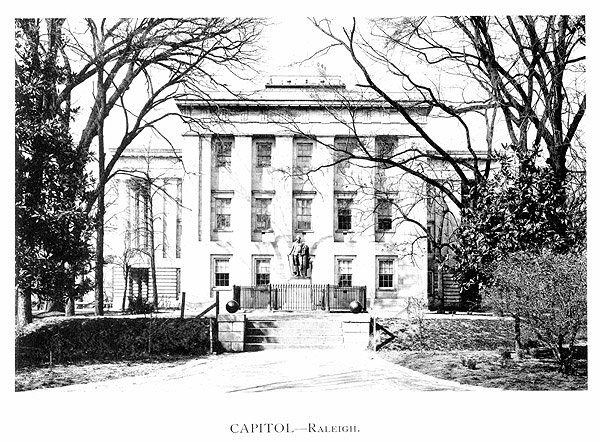
"The capital of North Carolina, a Raleigh, is a materialized echo of the past, in and about which there is no note of the transformation of the state and its people. Built sixty years ago by a slave-holding people, it has remained unchanged through the calamities of war and the brilliant evolution of the new spirit of enlightened industry. There it stands, classic, dignified, aged, but well preserved, as if it typified all that was good and enduring in the courtly, generous but feudal masters whose rule has passed away forever in the Old North State. The beautifully proportioned old palace stands embowered among trees at least as old and majestic as itself, in a rather modern-looking little park. The building is of granite, quarried near by. The last glimpse and the first, like all the views one gets of its interior, suggest such a strange blending of age and careful keeping as one notes in the ancient trinkets which now and then some wrinkled old spinster brings out to exhibit, as the choicest, tenderest, relics of a distant generation of her people.
"The walls and floor are clean and fresh, for instance, but on the doorway, to the assembly chamber is the strange legend, ‘Hall of Commons.’ An aged but diligent servitor who guides you wastes no time over the great portrait of Washington on one wall, but dwells feelingly upon the fact that in the cruel, tyrannical days of ‘carpet-bag rule,’ the negroes, who were then the legislators, broke two of the precious old hard-wood chairs, which were the especial treasures in that chamber. He takes you across the hall carrying with his spare, bent from a strong suggestion of a past as extensive as that of the capital itself, and then you are stirred by the sight of the prim but noble mahogany provided for the statesmen of the luxurious past to rest and to write upon. The old man stirs you in quite another way by the remark that a Northern firm has offered to exchange modern furniture for all that is in the old room. A bust of John C. Calhoun is the chief ornament in the senate chamber, though the neatness and reverential order that rule there strike you as better than any ornament could be.
You carry with you to the executive offices downstairs a mind wholly given up to reflections upon the past, and lo! The officials in those ancient rooms all but stun you with the zeal and zest with which they press you to consider the present needs of the state, its bustling progress, and its wealth of unworked resources. You hardly find a quicker spirit in Ohio or Rhode Island. Moreover there is little buncombe about it. If the y tell you, as they will, that no state in all our Union has such varied capabilities, or that its climate embraces nearly the full extremes that are represented in our minds by Maine and Florida, they make their words good by showing you photographs of the snow-silvered spruce forests of the western mountains, and palm littered, all but tropical views taken along the sunny coast.
They boast a little, as good Americans always do, and if some of the things they say show a trifle of jealousy, or if some of the topics they choose seem somewhat unsentimental, you must remind yourself that the jealousy springs from a pride that has been wounded, and that the best elements of wealth are not apt to be of a poetic nature. Thus they tell you that the excellent peanuts which North Carolina raises in abundance have failed to bring her the credit she deserves; and that the golden, beautiful tobacco, which for generations has been known as "bright Virginia leaf," so much admired for use in pipes and cigarettes, was and is largely grown in North Carolina. The way in which the Yankee-like old state came to be robbed of the credit for its peanuts was this: For years the farmers of eastern North Carolina have been raising the nuts and shipping them in crude condition to Norfolk. There they have been cleaned and bagged, and sold as Virginia Produce. This is yet the case, although the eastern North Carolina nuts are unexcelled by any others that are grown in the world. But the wedge of justice has been inserted in this case. The work of separating and cleaning the nuts has been begun ina small way by the North Carolina farmers, and the world at large will soon learn that though Virginia and Tennessee grow good peanuts, they never produce finer ones than are grown in North Carolina. As for the ‘goobers’ that gave Georgia its nickname of ‘the Goober State,’ they are poor and small by comparison. It is different with the splendid tobacco of the state. At last North Carolina is establishing a reputation for its own excellent ‘weed that cheers.’ Buyers now come to the North Carolina market-towns, and the best bright leaf is coming to be classed under its true name. The town of Durham, so famous among men who smoke, is the capital of the golden tobacco belt, which embraces ten or twelve counties in the middle of the state. The ‘mahogany’ or plug tobacco leaf is grown in the western part, and Winston, which maintains forty plug factories, is its industrial capital.
"From the Northern evergreen, to the Southern palm, is the measure of the state’s fertility, and her people do not hesitate to say all that should bridge the two extremes are also theirs. That they can do grow whatever is grown elsewhere in the United States is also true, with a few marked exceptions that distinguish the extreme South. It is the boast of the people that at Chicago’s great exposition no state displayed such a great variety of the products of the soil.
"Under such circumstances the most practical students of the commonwealth cannot be altogether prosaic in listing its products. If I have the good fortune to possess the eye of that friend whom the novelist always addresses as ‘fair reader,’ let me also turn directly to her and ask what she thinks of whole farms given up to tuberoses? Such, it seems, are among the triumphs of North Carolina husbandry. Some farms devote as much as twenty-five acres ‘in a patch’ to the cultivation of tuberoses. During the first year the tuberose bulb multiplies and does not flower. It is during the second year that it spreads its delicate, waxen and aromatic blossoms, and a great industry in this state is the development of the bulbs in the earth for the first year, and then the shipment of them to the North in barrels, to be sold by the florists and set out to blossom. North Carolina is chosen for this graceful branch of farming because of the properties of the soil, and because the bulbs can be kept out in it all winter. It is true that in fancy I see the pink and white nose of my fair reader lift a little at the disclosure that the suggested fields of aromatic flowers prove only to be furrows of raw earth, hiding bulbs; but only think how many of the flowers are not sent away, but mingle their beauty and sweetness with the vast bouquet that blossoms all over such a region. And only think, when next you see a tuberose bloom, that it was in the old state of North Carolina that it started on its fragrant and, alas! Too often pathetic mission.
"It will be equally interesting to all my readers, for I fear I have not been altogether successful with my special address to the fair ones alone, to know that in Raleigh thousands and tens of thousands of rose cuttings are planted in the gardens and fields for the Northern markets. The northern florists send the cuttings down to be planted and kept a year in order that they may grown roots, and that each may become a plant, a baby rosebush. Then they are shipped back in the spring to be sold as young plants. It is too expensive to do this under glass, as it would have to be done in the North; but it costs a mere trifle, by comparison, to assist nature at the task down in Raleigh; for in that clement city the people actually keep tulips, hyacinths and such plants out in their door-yards all winter.
"Thus does North Carolina so cheapen the flowers with which we deck ourselves and our homes, and which we have so long mistaken for Northerners, like ourselves. She may be said almost to hand them to us-in the profusion in which we have them, at least-as a charming sister brightens the chamber of a gallant knight.
"With the flowers go the fruits, as they properly should. The growing berries and garden trucks is an industry that has developed truly magnificent proportions in North Carolina. It is mainly confined to the sea-coast section, but it is rapidly covering the whole of the front of the state. This particular phase of the industrial revolution in the South, which we shall have to mention again and again as different sections are treated, may not be as revolutionary as the appearance of the cotton manufacture in such great force in three of the states, but it is, nevertheless, very remarkable. Along the Atlantic edge of Virginia, the Carolinas, Georgia and Florida, the planters in the ante-bellum time grew little else than cotton, and depended wholly on the money it brought for the purchase of everything else, even to the goods that were made of the cotton. If vegetables and small fruits were seen to grow on this island in those days, the fact made no impression and the insignificant produce got only contempt. But cotton fell in value; it proved itself a monarch in which too many persons had trusted blindly. There ensued as era of distress and gloom. It was in Southwestern Virginia, close to the borders of North Carolina, that the warm climate, the humid atmosphere and the rich soil were found to offer the essentials for maturing small fruits and vegetables in advance of those for which the Northern people waited yearly with impatience. Here truck farming grew from an experiment to a successful industry. Then came the travel to Florida as a winter resort, followed by an almost wild scramble for land in the stage for orange orchards,-a scramble to which, as I have shown, the land that grew poor oranges, went with the rest. The natural shortening of the journey between Florida and the North was rapidly brought about by railroad combinations and enterprise, and by the perfection and increase of steamship facilities. Thus easy access to the Northern market was offered all the coast line between Florida and Norfolk, the first market-town of the new trade in garden trucks. As each state grasped the new opportunity, the arrival of spring and summer produce was hastened in the North, and Georgia came to be first with her treasures, then South Carolina, nest North Carolina and then Virginia,-last where she had been first, but still in demand to lengthen the link between summer and summer, and to shorten the period of winter deprivation in the North. As early as 1884, Charleston alone was shipping half a million quarts of strawberries, a tenth as many barrels of potatoes, and 62,333 packages of vegetables in season.
" Today the commissioner of agriculture announces truck farming to be ‘among the foremost occupations in North Carolina as a money resource.’ The best district I around New-Berne, where there are 8,000 acres planted in strawberries, asparagus, green peas, cabbages, beans, kale, beets, turnips, Irish potatoes, tomatoes, cucumbers, egg-plants, radishes, etc. During the shipping season the railroad company has run from one to three trains a day from this district, and two steamers have made five trips a week laden with the produce. It is said, as a result of careful calculation, that this New Berne section realized $750,000 from its produce in the season of 1891, and the farmers netted half a million dollars. Wilmington, Elizabeth City, Goldsboro, are other large shipping points for other districts, but there are many others that are marked by mere railway sidetracks, where many cars are loaded daily in the season. There is a good deal of very enlightened farming down there, and in consequence there are farmers whose profits at the end of a single year are what the mass of men would call fortunes. On one, the farm most wisely managed perhaps, we find 170 head of cattle, 66 horses, 139 hogs, a dairy, a sawmill, for the needs of the box factory, and a fertilizer making plant. On this farm 600 acres were put into truck last year, and 300 were sown with oats and grass. When one considers how short a time it is since the farmers there were exclusively planters of cotton, and what a precarious living their methods brought, this seems indeed a long stride ahead.
"And this is not true merely of the trucker region of the coast. ‘The low price of cotton and high price of everything else,’ as one state official put it, ‘have led the farmers in great numbers to diversify their industry, and to raise what they consume at hone. Hogs, cattle, horses, milk, butter, fruit, vegetables and corn are products that are increasing rapidly. Sheep are also multiplying, though sheep raising calls for so much outlay in guarding the stock against dogs, that only men with capital make a business of it. Raleigh is now supplied with all the milk and butter it uses, though not sufficient dairying is done to make the products articles of export. The result of all this, as might have been expected, has been a remarkable removal of mortgages al over the state within the past few years. And this prosperity reflects upon the state itself, so that her debt is trifling, and at least one issue of bonds by the commonwealth rates almost as high as the bonds of the federal government.
" The revolution is also reflected in the cities. Wilmington is a bustling, wide-awake town, with a solid and very active business quarter, and all the superficial signs of a prosperous and ambitious population. Charlotte, the richest city in the state, has invested so heavily in cotton-mills and other ventures in various other towns and sections that it is said she would have a population of 60,000 were her industries all at home. It is doubtful whether the lace would then be as inviting as it is now, for though it is busy, it is also beautiful. Raleigh, the capital, which is so well shaded that a bird’s-eye view of it discloses little else than trees, is at once neat and substantial and rather more Northern than Southern looking, except for the (typically Southern) great width of its main streets. And yet these are paved and well cared for, besides being busy. The city is credited with 17,000 inhabitants, and maintains three cotton-mills, several machine shops, two fertilizer factories, an oil mil, car works, and several candy factories, one of which is celebrated far beyond Raleigh. It is also a trading centre, and has large commercial establishments. All these businesses are supplied with local capita, and it is important to add that this is generally the case in both the Carolinas.
"Raleigh has several fine educational foundations, but one that interested me very much indeed was the College of Agricultural and Mechanic Arts. The other Southern states possess more or less similar institutions, maintained with federal aid, and if they are in any great degree as well or even as proudly managed as this of North Carolina, it is a grand thing, particularly where men have been too prone to think it undignified to wrok for themselves. Here we find an expensively housed and well equipped institution, which, although only four years old, has already graduated one class, two-thirds of whose members obtained situations at once. Both teachers and pupils were alike enthusiastic when I went through the buildings. I found there a fine smithy, a forge room, a machine shop (in which stood a steam engine made by the graduates), a wood-turning department and junior work class-room, a very fine chemical laboratory presided over by an ambitious Cornell man, a modern barn, a dairy building, a large experimental farm, and an agricultural experiment and state weather station. The young men are here fitted to become intelligent, educated and practical farmers, horticulturists, cattle and stock raisers, dairy men, as well as machinists, carpenters, architects, draughtsmen, manufacturers, and contractors. I do not mean to claim too much in saying this; what I do mean is that they learn the rudiments of these occupations, as well as to use their brains and their hands. A full mathematical course is part of the curriculum, and a much more important source of strength to each pupil is the association with the ambitious young fellows of the state, and the daily intercourse with the able and accomplished members of the faculty. Here were some boys from very humble homes, and yet so intent upon becoming masters instead of dependants as to be found waiting on the others at the dining-table, in order to earn their living while they studied. A certain number of pupils admitted free, subject to an examination in rudimentary studies. They pay $8 per month for board and extras. But the good work of the institution does not stop there. The officers reply to all requests for information by the farmers of the state, and hold farmers’ meeting wherever requested, for the discussion of subjects connected with practical farming. Dr. H. B. Battle, as head of ht experiment station, also issues frequent and very valuable bulletins, sent free to thousands of farmers, telling them how to guard against insect pests, warning them against inferior or fraudulent fertilizers, discussing methods of farming, explaining how waste can be prevented, how they can determine the best thing to grow, and in a sentence scattering the most practical and most needed advice, in thick pamphlets as well as mere fly-sheets, among the agriculturists of the state. Farther yet, the station is pushing an almost unique plan of spreading the information by sending out stereotyped-plate matter free to the newspaper of the state. Alexander Q. Haladay, Esq., is the president of the college and its allied farm and station.
"Leaving agriculture out of further consideration, we will observe that for variety the resources of the state do not depend upon that industry, though it is, of course, mainly and primarily a farming state. But its turpentine stills are a source of revenue; its forests are of great extent and value; its fisheries employ about 6,000 persons; its gold-mining is carried on in several counties, and the quarrying of marble, granite, sandstone, and of Belgian blocks for the paving of the city streets, is done in many parts of the state.
"The story of the traveler who, on being shown a beautiful piece of mahogany furniture, replied, ‘Yes, where I live they make fence rails of mahogany,’ could be paralleled by many citizens of western North Carolina if any were called upon to admire a granite building, for they might truly say that in their parts of the state there are towns where all the fence posts are made of granite. Coal-mining is a new industry in North Carolina, but it is carried on with all the rest. There are two coal belts there. A company of Northern capitalists is working a rich field of good bituminous coal of Egypt, and another Northern company owns some mines of what is called semi-anthracite, a little southwest of that place. At King’s Mountain a company has been formed to develop a tin-bearing region, which it is thought they can mine profitably.
"The exporting of grapes and even the manufacture of wine have been a source of revenue to North Carolina during a quarter of century. A new and quickened interest in these businesses is shown in the gradual multiplication of vineyards and in the profits and growth of certain of the older ones; and, since wild grapes are said to have grown naturally all over the state, these may yet become important industries. Mineral springs of more or less celebrity are numerous; and of popular resorts for tourists and invalids, led by the thriving and beautiful town of Asheville, there are many, as well as sites for ten times as many more, in the healthful and picturesque mountain districts. The population of the state is no greater than that of New York city, but unlike South Carolina, the whites are nearly twice as numerous as the negroes, the difference (according to the last census) being that there were 1,055,382 whites and 562,565 colored persons. One would argue from this fact that North Carolina would attract immigrants in greater number than almost any of the southerly states, and yet in 1890 there were only 3,742 foreign born persons in the state. John Robinson, Esq., the commissioner of agriculture, says upon this subject: ‘The immigration into North Carolina is largely from New England, middle and some of the Northwestern states, and gives many and much desired and much valued accession to sources of material development.’
"It seems, then, to whatever small extent this increase comes, the Old North State is enjoying what the most influential men in all the southern states desire and demand. The South wants men with capital, and not men with mere hands and energy and willingness to work. It wants men who will buy and cultivate plantations, who will establish mills, and who will organize corporations for the development of its resources."
ALEX GRAHAM.